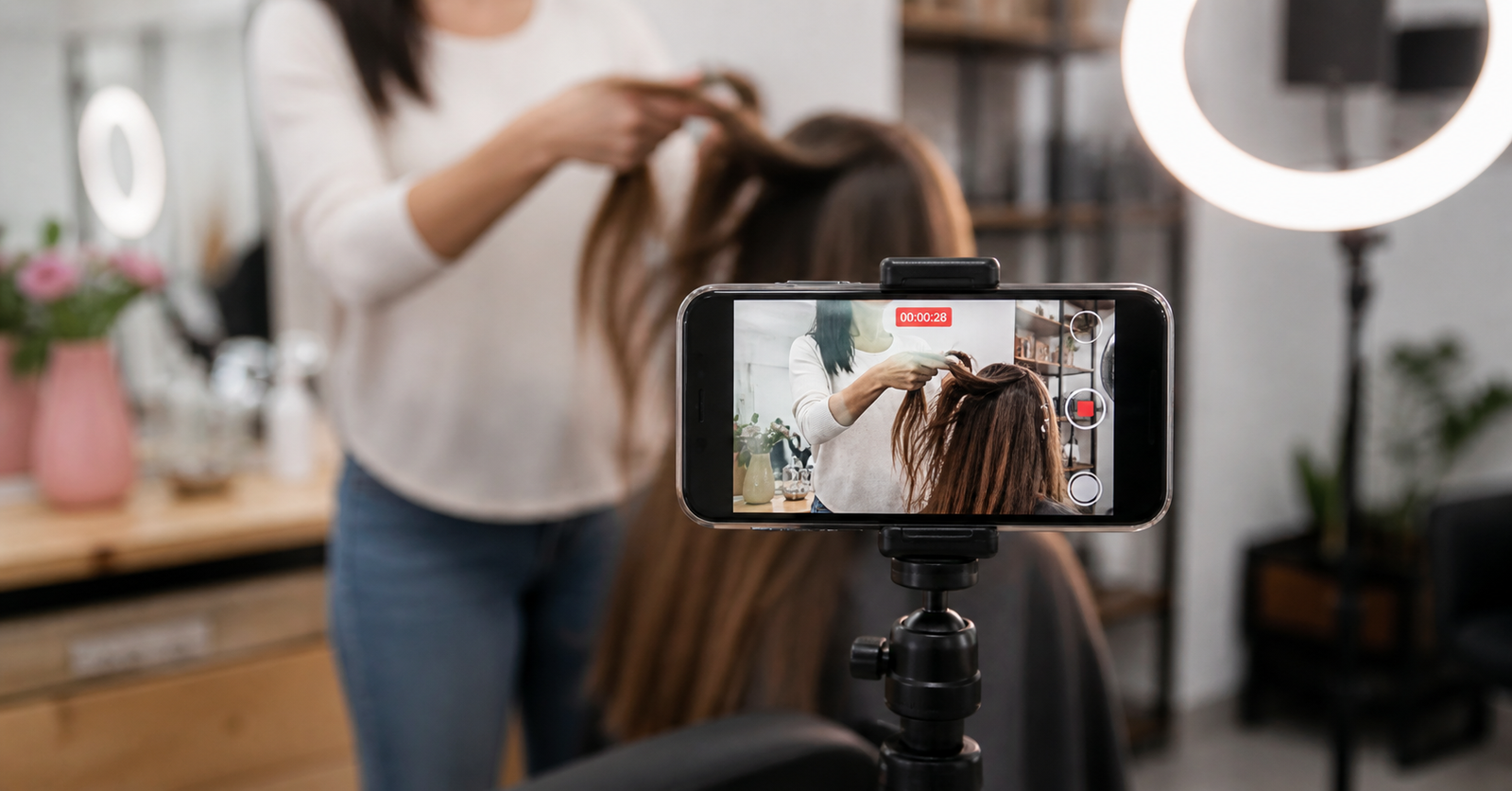
Almost every salon owner has been told they need to be on TikTok and Reels. Almost none of them have been told how. The result is a lot of salons posting transformation videos with no hook, dancing trends that don't fit their brand, and 80-view content that takes hours to produce. The good news is short-form video genuinely works for salons in 2026 — the salons doing it right are pulling in 30-100 new clients a month from a single account. The bad news is that the rules are different from every other social channel, and most of the advice still floating around is from 2022. Here's what actually works now.
Why short-form video matters more than feed posts in 2026
TikTok and Instagram Reels are now where 18-44 year olds discover salons. Static feed posts in 2026 are seen mostly by people who already follow you. Short-form video is the only channel where you can reliably reach people who don't know you exist yet.
The honest math has changed. In 2018, an Instagram feed post might reach 30-40% of your followers. In 2026, it reaches closer to 3-5%. Reach on Instagram and Facebook has been collapsing for years, and the algorithm has shifted decisively toward video.
What this means in practice: your feed posts are now mostly seen by people who already follow you. They're maintenance content — they signal you're active and consistent. They don't drive new client discovery.
Short-form video is different. The TikTok algorithm and Instagram's Reels algorithm both serve videos to non-followers based on engagement signals (watch time, completion, shares). A salon Reel can hit 5,000-50,000 views in 48 hours — and a meaningful percentage of those viewers will be local women who don't yet follow you.
For salons specifically, the discovery dynamic works because of how clients search. They don't necessarily search "balayage near me" — increasingly, they scroll Reels and TikTok, see a transformation, save it, and book the salon that posted it. That's a completely different funnel than the one most salons are still optimizing for.
The strategic point: if you only have time for one social channel in 2026, it's short-form video — not feed posts. Feed posts maintain. Reels grow.
The five content types that actually work for salons
Salon Reels and TikToks that perform consistently fall into five categories: transformations, education, behind-the-scenes, point-of-view client experience, and 'what you didn't know.' Skip dancing trends, generic motivational quotes, and anything that requires lip-syncing — they don't convert salon viewers into bookings.
The mistake most salons make is trying to follow general TikTok trends. The salons winning the platform are creating salon-specific content that fits clear formats. There are five that consistently work:
1. The transformation. Before, process, after — usually 15-30 seconds. The hook is in the first 2 seconds: show the most dramatic point of the transformation, not a "Hi welcome to my salon" intro. Best for color, extensions, lash sets, brow services. The math: transformation videos pull 5-20× the average view count of any other content type for salons.
2. Education. "Here's why your at-home color always turns brassy." "The reason your lashes are falling out faster lately." Quick, specific, useful. Position the stylist as the expert. These don't go as viral as transformations but they convert viewers into followers (and eventually clients) at high rates because they build authority.
3. Behind-the-scenes. A 30-second walk through how a balayage is actually done. The mixing bowl, the foils, the timer. Clients are deeply curious about how this works and almost never see it. BTS content humanizes the salon and makes prospective clients comfortable with the process before they book.
4. Point-of-view client experience. "POV: you walked into your appointment with a Pinterest screenshot." Filmed from the client's perspective, showing the consultation, the process, the reveal. Highly engaging because it's empathetic content — viewers see themselves in the chair.
5. The "what you didn't know" hook. "What you didn't know about extensions." "Three things your stylist won't tell you about box dye." These are pure information arbitrage — viewers stop scrolling because they want to know what they don't know. High save rate, high share rate.
What to skip: dancing trends (almost never fit a beauty business well), lip-syncs (low engagement for service businesses), generic motivational quotes ("Mondays are for new beginnings ✨"), and anything that requires you to look at the camera and talk for more than 30 seconds straight if you're not naturally good at it.
The first two seconds rule (this is everything)
On TikTok and Reels in 2026, the first 2 seconds of your video determine whether it gets shown to 1,000 people or 50,000. If a viewer doesn't stop scrolling in those 2 seconds, the algorithm decides your content isn't worth distributing. Lead with your strongest visual moment — never with talking, never with a logo intro.
The biggest single mistake salon accounts make is wasting the first 2 seconds. The video starts with: a logo animation, a "hi guys, today I'm going to..." voice intro, an empty chair before the client arrives, or worse, a 3-second pause before anything happens.
Every one of those is a scroll trigger. The viewer is gone before you've shown them anything.
The rule: open on the most visually arresting moment of the video. If it's a transformation, open on the dramatic mid-process shot or the final reveal — not the "before." If it's education, open with the surprising claim ("Your blonde turning brassy isn't your fault"). If it's POV, open with a striking visual or text overlay.
Specific tactics that work:
- Text-on-screen hooks. A bold text overlay in the first frame that names the payoff. "How I fixed her box-dye disaster in 90 minutes." Viewers stop because they want the resolution.
- Visual pattern interrupts. Open mid-transformation, with foils everywhere or hair half-bleached. The visual oddness stops the thumb.
- Zero dead time. Cut every silent or transitional moment. If the action takes 18 seconds in real life, the video should be 12 seconds.
- Front-load the "after." Counter-intuitively, showing the result first — then the process — outperforms classic before-process-after structure on TikTok in 2026.
One useful test: watch your last five videos at 1× speed with no sound. Did you stop scrolling internally on the first frame? If not, neither will anyone else.
Posting cadence and where to post (TikTok vs Reels)
Post 3-5 short-form videos per week. Cross-post the same video to both TikTok and Instagram Reels. Don't post the same video to YouTube Shorts unless you have time to edit it specifically — algorithm performance there differs significantly. Quality matters more than quantity, but consistency matters more than perfection.
The most common questions: how often to post, where to post, and whether cross-posting hurts you. Here's what's working in 2026.
Cadence: 3-5 short-form videos per week is the sustainable sweet spot for most salons. Below 2/week, you don't generate enough algorithmic data for either platform to figure out who to show your content to. Above 7/week, you typically burn out within 6 weeks. Consistency beats volume.
Cross-posting: Yes, post the same video to both TikTok and Instagram Reels. The myth that cross-posting hurts you is largely outdated for 2026 — both platforms have downplayed watermark detection significantly. If you're using a TikTok-watermarked video on Reels, that can still slightly suppress reach, so save the unwatermarked version from TikTok before posting (or use a tool like SnapTik to remove the watermark).
YouTube Shorts: Worth it only if you have the bandwidth. The audience demographic skews slightly different (more male, more older). For most salons, the ROI on cross-posting to Shorts isn't worth the time unless you're already producing 5+ videos per week.
Best posting times: Less critical in 2026 than people make it seem. Both algorithms now distribute content based on engagement velocity over the first 4-6 hours, regardless of post time. Post when you have a good video, not when "the algorithm wants you to."
Hashtags: Less important than they used to be. Use 3-5 relevant hashtags — a mix of niche (#nashvillehairstylist) and slightly broader (#balayagespecialist). Skip generic massive ones (#hair, #beauty) — they're too noisy to help you.
The conversion bridge: from views to bookings
Views don't book clients. Your bio link, pinned content, and DM response time do. Most salons get 50,000 views and 0 bookings because their bio is empty, their booking link is buried, and they don't reply to DMs for 3 days.
This is where most salons fall apart, and where the best ones quietly dominate. A viral Reel or TikTok is worth zero dollars unless the conversion path is set up to capture intent.
The four critical pieces:
- Bio reads in 2 seconds. Service + city + what makes you different + booking link. "Balayage specialist · Austin · Online booking ↓" — not your life philosophy. We covered this in detail in our Instagram bio formula post.
- One-tap booking link. Use Linktree, Beacons, or your direct booking page. The link should go to a page where a viewer can book within 3 taps. If your "Book" link goes to a page that says "Call us!", you're losing every viral viewer.
- Pinned posts that close the sale. Pin three posts: your best transformation (proves you're skilled), a price/process explainer (removes the most common objection), and a testimonial Reel (builds trust). Anyone who lands on your profile from a viral video sees these first.
- DM response time under 4 hours. Almost every viral video generates DMs ("how much for balayage?" / "do you have any availability?"). Salons that reply within 4 hours convert these at 30-50% rates. Salons that reply 2 days later convert at almost zero. If you're going to be on these platforms, you have to commit to the DM follow-up.
One non-obvious thing: viewers who DM are usually serious. They've already watched your content, decided they like your work, and are now reaching out. The DM is the booking, in disguise. Treat it accordingly.
What not to do (the common mistakes that kill salon accounts)
The four most common salon TikTok/Reels mistakes: dancing trends that don't fit your brand, all-talking-head content, posting only finished results without process, and ignoring the comments section. Each of these caps your growth at about 1,000 followers no matter how often you post.
The mistakes are predictable. If you're hitting any of these, fix them before posting more content — the algorithm is already learning your patterns.
Don't do dancing trends just because they're trending. A balayage specialist doing a TikTok dance to a popular song doesn't look like the kind of stylist clients want to book. The brand mismatch costs you more than the trend visibility gains. Trends only work for salons when they fit naturally — usually that means audio trends, not dance trends.
Don't post all talking-head content. Watching someone talk into a camera for 45 seconds is a tough sell unless they're an unusually engaging personality. For most stylists, doing some talking-head content is fine, but the bulk of your content should be visual — transformations, process, BTS. The action carries the watch time.
Don't post only finished results without showing process. Static "after" shots get a quick scroll on Reels. The transformation arc — even compressed to 8 seconds — is what holds attention. A viewer who watches the whole arc is far more likely to follow, share, or book.
Don't ignore your comments section. Responding to comments in the first hour of a video posting boosts the algorithm's distribution of that video. Even quick replies ("thank you!" / "she's gorgeous!") help. Salons that reply to their first 20 comments on every video grow noticeably faster than salons that don't.
Don't post pure self-promotion. "Book your appointment now! 30% off!" content gets buried by both algorithms. The platforms reward content that keeps users on-platform — not content that pushes them off. Save the booking pushes for your bio link and pinned posts. Use the videos themselves to demonstrate skill.
What to do this week
1) Pick ONE service you do exceptionally well and film 3 transformation videos this week. 2) Update your bio with a one-tap booking link. 3) Pin three strong posts to the top of your profile. 4) Commit to replying to every comment and DM within 4 hours for the next 30 days.
You don't need a content strategy document. You need to start producing video this week and learn from what happens. Here's the priority order.
This week:
- Pick one signature service. The thing you do better than your competitors. Balayage, lash sets, brow lamination, color corrections — one specific service. Your content will be 80% about this for the next 60 days.
- Film 3 transformation videos. Same format each time: dramatic before-frame hook, fast-cut process (10-15 seconds), satisfying reveal. Vertical, 9:16 aspect ratio.
- Update your bio. Service + city + booking link in the first line. Drop the "passion for beauty since 2014" filler.
- Pin three posts to the top of your profile: best transformation, price/process explainer, recent testimonial.
This month:
- Set a weekly filming day. Friday afternoon, before your last appointment. Knock out 3-5 videos in 90 minutes from clips you took during the week.
- Track which videos hit. After 30 days, look at your top 3 videos. Whatever made those work — the format, the hook, the song — do more of that.
- Engage in your DMs and comments daily. 10 minutes a day, no more. Reply, save the booking conversations, move on.
Most salons trying short-form video give up after 2 weeks because nothing went viral. The truth is most accounts need 30-60 days of consistent posting before the algorithm figures out who to show your work to. The salons that win are the ones that don't quit during that learning period.
Frequently Asked Questions
How long should a salon TikTok or Reel actually be in 2026?
The sweet spot for transformation content is 12-25 seconds. Education and POV content can run 25-45 seconds. Anything past 60 seconds drops off significantly in completion rate, which hurts algorithmic distribution. Shorter, tighter videos almost always outperform longer ones for salons.
Do I need professional lighting and equipment?
No. A modern smartphone, decent natural window light, and a $20 phone tripod are enough to start. The biggest production upgrade for most salons is a clip-on phone microphone (around $30) for any talking content. Don't buy a camera, ring lights, or expensive editing software until you've posted at least 50 videos.
Should I get my clients to sign a release before posting them?
Yes — get verbal or written permission for every client featured. A simple phrase at the start of the appointment works: 'I'd love to film some of this for our social — totally fine if you'd rather I didn't.' Some clients prefer to be shown only from the back or hands-only. Honor those preferences. Posting a recognizable client without permission is both legally risky and a relationship-killer.
What's the right balance between TikTok and Instagram Reels for a salon?
For most US salons, Instagram Reels has a slightly older, slightly more affluent audience that aligns better with most salon price points. TikTok skews younger and more discovery-oriented. Post the same video to both — the marginal cost is two minutes — but if you have to prioritize, lean into Reels for converting clients and TikTok for top-of-funnel awareness.
How do I handle a video that goes unexpectedly viral?
Three things: 1) reply to comments aggressively for the first 6-12 hours — algorithm signal multiplier. 2) Make sure your bio and booking link are ready to capture the traffic. 3) Don't change your strategy or pivot to chasing viral. Most viral videos are partly unpredictable, and trying to recreate them rarely works. Stay consistent with what's been working.
Are paid TikTok or Instagram Reels ads worth it for salons?
Generally no, especially for organic-first beauty businesses. Both platforms reward authentic, native content over paid pushes — and the cost-per-acquisition for salon services from paid social tends to be high. The exception is occasional boosted posts of your top organic performers, which can add reach affordably. We compared paid vs organic in detail in our SEO vs paid ads post.