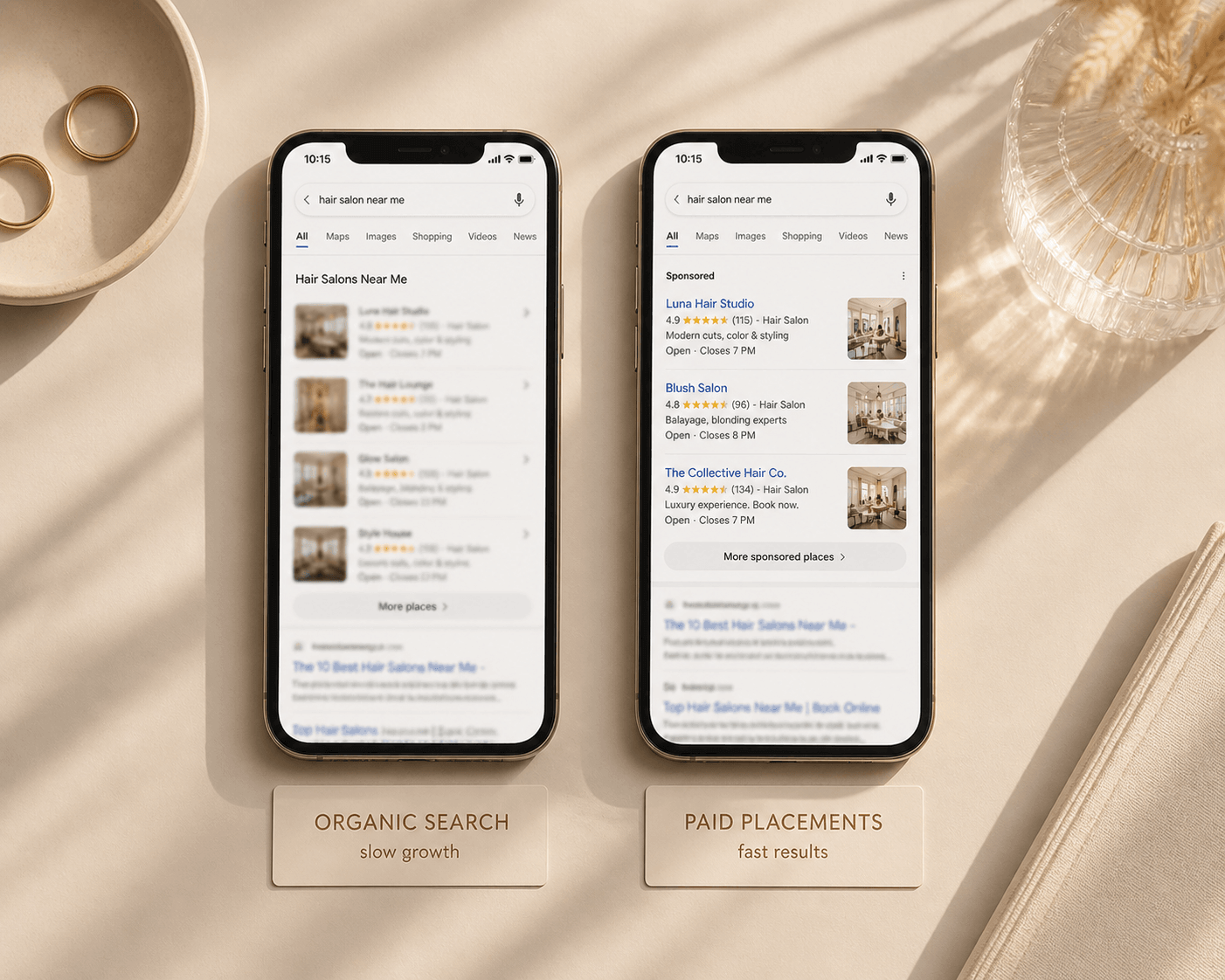
Most salon marketing advice frames SEO and paid ads as either-or — either you 'do SEO' or you 'run ads.' That framing is wrong, and it leads to bad decisions. SEO and paid ads have different time horizons, different cost structures, and different purposes. The right strategy almost always involves both, in proportions that depend on your stage and goals. This post breaks down what each actually does, when each works, and how to decide what to invest in first.
What each actually is
Local SEO is the work of ranking organically in Google search and Maps without paying Google. Paid ads are payments to Google or Meta to put your business in front of users immediately. They look similar in results but have completely different economics.
Quick definitions to make sure we're talking about the same things:
Local SEO includes everything that helps your salon rank organically in Google Maps, the local 3-pack, and standard Google search results. This is unpaid traffic — Google ranks you based on signals like Google Business Profile completeness, reviews, citations, and website quality.
Paid ads means money paid to Google (Google Ads) or Meta (Facebook/Instagram Ads) to display your business to specific audiences. This is paid traffic — when you stop paying, the traffic stops.
The two often appear in the same Google search results — sometimes within inches of each other on the screen — but they cost very different things and last very different amounts of time.
Local SEO: slow to build, durable when it lands
Local SEO takes 3-6 months to produce meaningful results, but each ranking gain compounds and persists. The cost-per-booking decreases over time as the foundation strengthens. It rewards consistency and patience over speed.
The honest case for local SEO: it's a long-game investment that pays compounding returns. Once you rank in the local 3-pack for high-value queries, that ranking continues producing bookings without ongoing payment to Google.
What local SEO does well:
- Captures high-intent searchers ("hair salon near me")
- Builds long-term trust signals that compound
- Costs decrease per booking over time
- Defensible — competitors can't pay their way past your rankings
- Strong return on investment for established salons
What local SEO does badly:
- Slow to produce results (3-6 months minimum)
- Doesn't help if your target market is searching but your area is hyper-competitive
- Hard to predict timeline of results
- Requires consistency over months/years to maintain
If you have time and patience, SEO is the better investment. If you need bookings this week, it's not the answer.
Paid ads: instant traffic, no compounding
Paid ads produce traffic within days but stop the moment you stop paying. They're useful for filling immediate capacity, testing offers, and supplementing organic rankings — but the cost-per-booking doesn't decrease over time the way SEO does.
The honest case for paid ads: they produce results immediately and predictably. If you launch a Google Ads campaign today with a reasonable budget and decent targeting, you can have bookings within 48 hours.
What paid ads do well:
- Generate bookings immediately
- Fill specific capacity gaps (slow Tuesdays, new stylist's open schedule)
- Test offers and messaging quickly
- Reach searchers your organic rankings haven't yet captured
- Useful as a bridge while SEO matures
What paid ads do badly:
- Stop entirely when you stop paying
- Cost-per-booking doesn't decrease over time
- Click prices in competitive markets can be brutal ($5-15 per click for salon keywords in some metros)
- Easy to waste money if targeting is loose
- Don't build any lasting asset
If you need bookings now, ads are the answer. If you want to stop paying for traffic eventually, ads alone won't get you there.
The right ratio: depends on your stage
New salons should weight toward paid ads (60-70% of marketing spend) while building SEO foundation. Established salons should invert this (60-70% on SEO maintenance and improvement, 30-40% on paid ads as supplement).
The optimal balance changes dramatically based on where your salon is in its lifecycle:
New salon (0-12 months):
- 60-70% paid ads — you need bookings to survive, can't wait 6 months for SEO
- 30-40% SEO foundation — start the long-term work even while ads carry you
Salon in growth phase (12-36 months):
- 40-50% SEO — foundation should be paying off, push it harder
- 40-50% paid ads — fill capacity gaps, test new services
Established salon (3+ years, stable revenue):
- 60-70% SEO maintenance and improvement — protect rankings, expand reach
- 30-40% paid ads — supplement and fill specific gaps
Salon at capacity:
- SEO maintenance only — no point driving more traffic to a fully booked salon
- Paid ads only for specific gap filling (slow days, new services)
- Surplus marketing budget should go to retention and pricing optimization instead
When SEO fails (and ads are the answer)
SEO fails when you need immediate bookings, when your market is too small to justify the timeline, when you're in temporary high-competition periods, or when capacity needs to be filled tomorrow.
SEO is the better long-term play for most salons, but there are honest scenarios where paid ads are clearly the right call:
- Brand-new salon, immediate cash flow needed: Don't wait 6 months for SEO. Run ads while building SEO simultaneously.
- Filling specific capacity gaps: Empty Tuesdays, a new stylist with open availability, slow seasons. Ads can target these specifically.
- Testing new services or offers: Want to know if a new service will sell? Ads tell you in days. SEO would take months.
- Hyper-competitive metros: In some Miami or LA neighborhoods, breaking into the local 3-pack is genuinely hard. Ads may be necessary while SEO catches up.
- Major life events affecting your salon: Move, rebrand, key stylist leaving. Ads provide stability while organic signals adjust.
When ads fail (and SEO is the answer)
Ads fail when costs-per-click in your market exceed sustainable booking economics, when you've been running ads for months without organic improvement, when ad fatigue sets in, or when the math just doesn't work.
Conversely, paid ads aren't always the right answer:
- Cost-per-click exceeds sustainable economics: If a Google click costs you $8 and your average booking value is $80, you need to convert better than 1-in-10 clicks just to break even before any other costs. The math sometimes doesn't work.
- Long-term reliance on ads with no SEO investment: If you've been running ads for 2 years and still can't stop without losing bookings, you have a structural problem.
- Ad fatigue: Same audience, same creative, same messaging — performance decays over time and you're always chasing fresh creative.
- Established salons with strong organic potential: Salons with great service and 3+ years of history often leave significant SEO upside on the table by relying on ads.
The honest answer most marketers won't give you
For most established salons, the answer is invest more in SEO and use paid ads tactically. For new salons, ads are necessary in the first year. The 'pure SEO' or 'pure ads' strategies are usually suboptimal — both have a role.
The honest answer that doesn't fit cleanly into either an SEO agency's pitch or a paid ads agency's pitch: most salons should be doing both, in proportions that change over time.
SEO agencies will tell you ads are a waste because they want long-term retainers. Paid ads agencies will tell you SEO is too slow because they want immediate budget. The truth is messier and depends on your specific situation:
- Year 1 salon → ads carry you, SEO compounds
- Year 2-3 salon → SEO and ads both matter, balance shifts toward SEO
- Year 3+ salon → SEO is the foundation, ads supplement
- Capacity-constrained salon → marketing investment shifts to retention and pricing
If you're trying to decide where to invest first, get a free audit that looks at both your current SEO position and your market's paid ad economics. The right answer depends on specifics that generic advice can't address.
Frequently Asked Questions
How much should I budget for paid ads vs SEO?
Can I do SEO without paying anyone?
How long should I test paid ads before deciding if they work?
Are Facebook/Instagram ads or Google Ads better for salons?
Will SEO eventually replace my need for paid ads?
What's worse: spending too little on marketing or spending it badly?
Ready to see what's costing your salon clients?
Get a free audit of your website, booking flow, and Google visibility. No cost, no pressure, delivered within one business day.
Contact Us