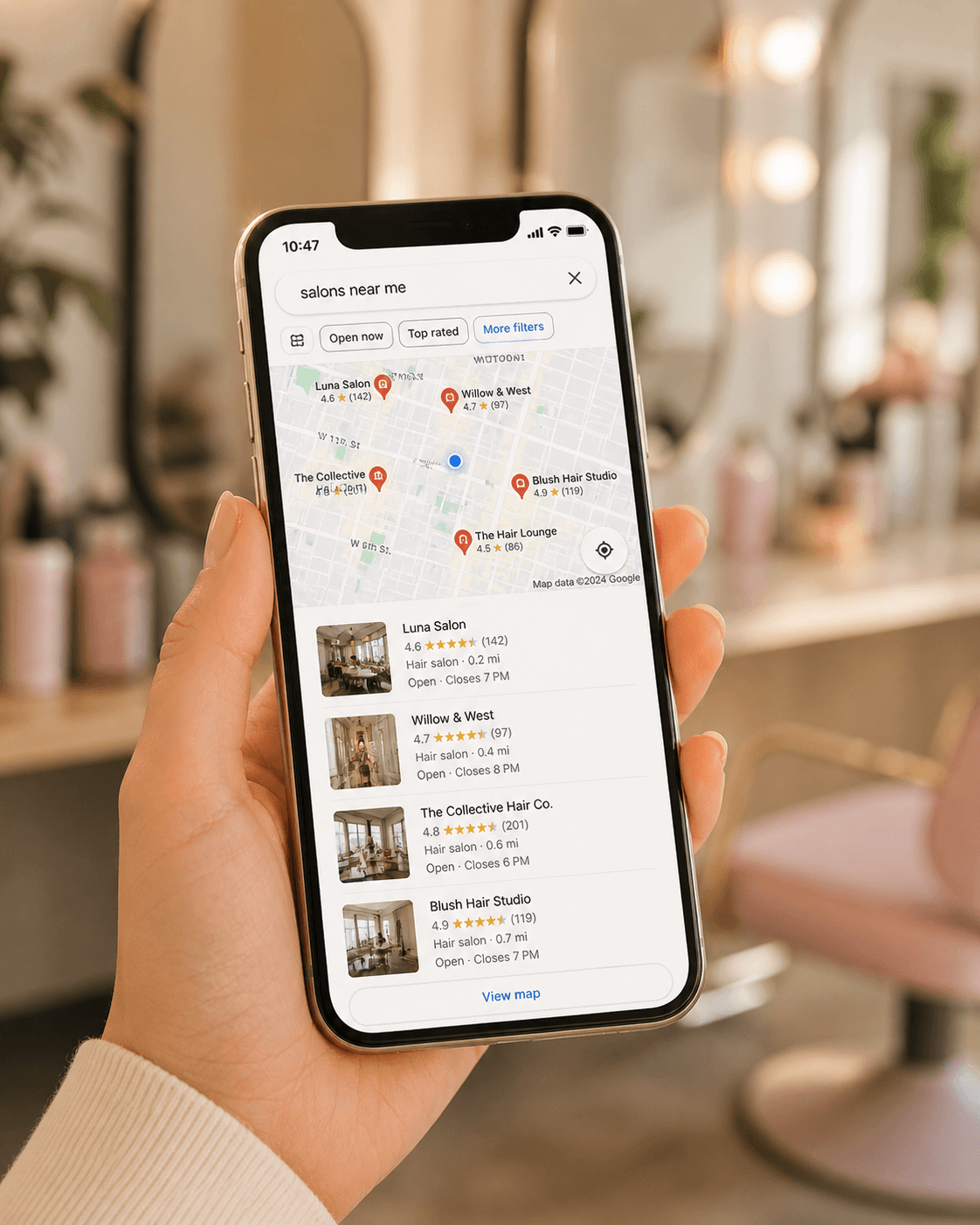
If you've searched for "how to rank a salon on Google" before, you've probably been overwhelmed by contradictory advice. This guide cuts through the noise. It walks through what actually drives local rankings for salons in 2026, in the priority order that matters, with no vague theory and no outdated tactics. By the end, you'll know exactly where to focus first.
What "ranking on Google" actually means for a salon
For salons, "ranking on Google" really means appearing in three places: the local 3-pack at the top of search, Google Maps results, and the standard organic links below the map. Each has different ranking factors.
When most people say they want to "rank on Google," they're conflating three different results that show up for queries like "hair salon near me." Understanding which one you're trying to win matters because each works differently:
- The Local Pack (top 3-pack): The three local businesses Google shows at the top with a map. Highest visibility, most clicks. Driven mostly by Google Business Profile signals.
- Google Maps: The full Maps results when someone clicks "more places" or searches inside the Maps app. Same ranking signals as the Local Pack but shows more competitors.
- Organic search: The traditional blue-link results below the map. Driven by website signals — content, technical SEO, backlinks.
For most salons, the Local Pack and Maps results are where 80%+ of bookings come from. That means Google Business Profile optimization should be your #1 priority — not website redesigns or blog content (yet).
Google Business Profile is the foundation
A complete, accurate, regularly updated Google Business Profile is the single most important ranking factor for local salon search. Get this right before anything else.
Your Google Business Profile (formerly Google My Business) is the single biggest lever for local salon search rankings. If it's incomplete, inconsistent, or unverified, no amount of other optimization will overcome that gap. Here's the priority checklist:
- Verify your business. If the blue checkmark isn't there, none of the other work matters.
- Choose the most specific primary category. "Hair Salon" beats "Beauty Salon" if you do hair. "Lash Extensions Service" beats "Beauty Salon" if you're a lash artist.
- Add every relevant secondary category. Don't stop at one. List every service category that applies.
- Fill out every service with a description. Each service should have its own listing, with a clear description and price or price range.
- Upload at least 25 photos in the first 30 days. Salons with 50+ photos consistently outrank those with fewer than 10.
- Set complete hours, including special holiday hours. Inconsistent hours signal an inactive listing.
- Use Google Posts weekly. Even a simple "this week's available appointments" post signals an active business.
Salons that complete every field of their profile rank significantly higher than those with incomplete profiles, even when the incomplete profiles have more reviews. Completeness is a ranking factor.
Reviews matter — but quantity, recency, and response all factor in
More reviews help, but recent reviews and your responses to them matter more than total volume. A salon with 40 reviews from the last six months will often outrank one with 200 reviews from years ago.
Reviews are one of the strongest signals Google uses for local rankings, but the way they're weighted has shifted significantly. What matters now:
- Recency: Reviews from the last 90 days carry more weight than older ones. A steady stream of recent reviews beats a one-time burst.
- Response rate: Salons that respond to reviews — both positive and negative — rank higher than those that don't. Responding within 48 hours is the practical target.
- Review keywords: Reviews that mention specific services ("balayage," "deep tissue facial," "lash fills") help Google understand what services you actually provide. This is why generic "great salon!" reviews are less valuable than detailed ones.
- Star rating: Yes, average star rating still matters, but it's less of a ranking factor than most assume. A 4.6 with consistent volume often outranks a 4.9 with sporadic reviews.
The practical implication: build a system to ask every client for a review at the right moment (typically 24 hours after their appointment, when the experience is fresh but they've had time to enjoy the result). And respond to every single review.
Local citations and NAP consistency
NAP (Name, Address, Phone) consistency across the web is a major local ranking signal. Inconsistencies between your Google profile, website, Yelp, Facebook, and other directories actively hurt rankings.
Google cross-references your business information across the web to verify legitimacy. When your salon is listed inconsistently — a different phone number on Yelp than on your website, or a slightly different business name on Facebook — Google trusts your listings less.
The directories that matter most for salons in 2026:
- Google Business Profile
- Your website (the source of truth)
- Yelp
- Apple Maps / Apple Business Connect
- Bing Places for Business
- Industry directories (Vagaro, Booksy, StyleSeat, etc.)
Pick one canonical version of your business name, address, and phone. Update every directory to match exactly — including punctuation and abbreviations. "123 Main St." and "123 Main Street" register as different to Google's matching algorithms.
Your website still matters — for organic results and trust
Your website doesn't drive local pack rankings as directly as Google Business Profile, but it strongly influences organic rankings, builds trust signals, and supports conversion when visitors do find you.
Many salon owners hear "Google Business Profile is the priority" and assume their website doesn't matter. It does — just for slightly different reasons:
- Organic search rankings: When someone searches for specific services like "balayage Tampa" or "lash lift near me," your website pages can rank in the standard blue-link results below the local pack.
- Trust signal for the Local Pack: Google checks whether your website backs up what your Google profile claims. Mismatches hurt local rankings.
- Conversion: Even if your Local Pack ranking gets visitors to your site, the site itself has to convert them into bookings.
Practical website priorities for SEO: clear service pages with descriptions and prices, a fast mobile experience, structured data (Schema.org markup), and at least a few pieces of useful local content (blog posts, neighborhood pages, or service-specific landing pages).
Realistic ranking timelines
Local SEO improvements for salons typically begin showing measurable results within 30 to 90 days. Significant ranking shifts can take 3 to 6 months. Anyone promising faster results is overpromising.
Be wary of any agency or guide that promises dramatic ranking improvements in two weeks. Local SEO is a slow-compound system, and Google's algorithms intentionally smooth out short-term ranking fluctuations.
Realistic expectations:
- Week 1-2: Initial Google Business Profile optimizations may show small ranking improvements, especially if your profile was very incomplete before.
- Month 1-3: The early ranking lift from foundational fixes (verification, complete profile, NAP consistency, initial photos) typically lands here.
- Month 3-6: Sustained improvements from review velocity, regular Google Posts, and content additions begin compounding.
- Month 6+: The bigger ranking shifts — especially in competitive markets — usually take this long.
If a salon doesn't see any movement within 90 days of focused local SEO work, something is wrong with the approach. But expecting page-one rankings in 30 days is unrealistic in most markets.
What to focus on if you only have 5 hours per month
If you have limited time, prioritize: reviewing and responding to reviews (1 hour), posting weekly to Google Business Profile (30 minutes), uploading 3-5 new photos (30 minutes), and checking your service listings for completeness (1 hour). The remaining time should go to NAP consistency checks across directories.
Most salon owners don't have unlimited time. If you can dedicate five hours per month to local SEO, here's where each hour should go:
- Hour 1 — Reviews: Ask 5-10 recent clients for reviews. Respond to every review you've received since last month.
- Hour 2 — Google Posts: Create 4 weekly posts (one per week) showcasing services, availability, before/after work, or seasonal promotions.
- Hour 3 — Photos: Upload 3-5 new photos. Mix categories: interior shots, work examples, team photos, products.
- Hour 4 — Audit your service listings: Make sure every service you offer has its own entry in Google Business Profile, with description and price.
- Hour 5 — Citation check: Pick 2 directories (Yelp, Facebook, Apple Maps, etc.) and verify the information matches your website exactly. Fix any drift.
Five hours per month, done consistently, will outperform 20 hours done once and then forgotten. Local SEO compounds.
Frequently Asked Questions
How long does it take to rank in the local 3-pack on Google?
Do I need to pay Google to rank well in local search?
How many reviews do I need to rank well?
What's the difference between Google Maps SEO and regular Google SEO?
Should I hire someone to do my salon's local SEO or do it myself?
Does my salon's website domain age matter for local SEO?
Ready to see what's costing your salon clients?
Get a free audit of your website, booking flow, and Google visibility. No cost, no pressure, delivered within one business day.
Contact Us