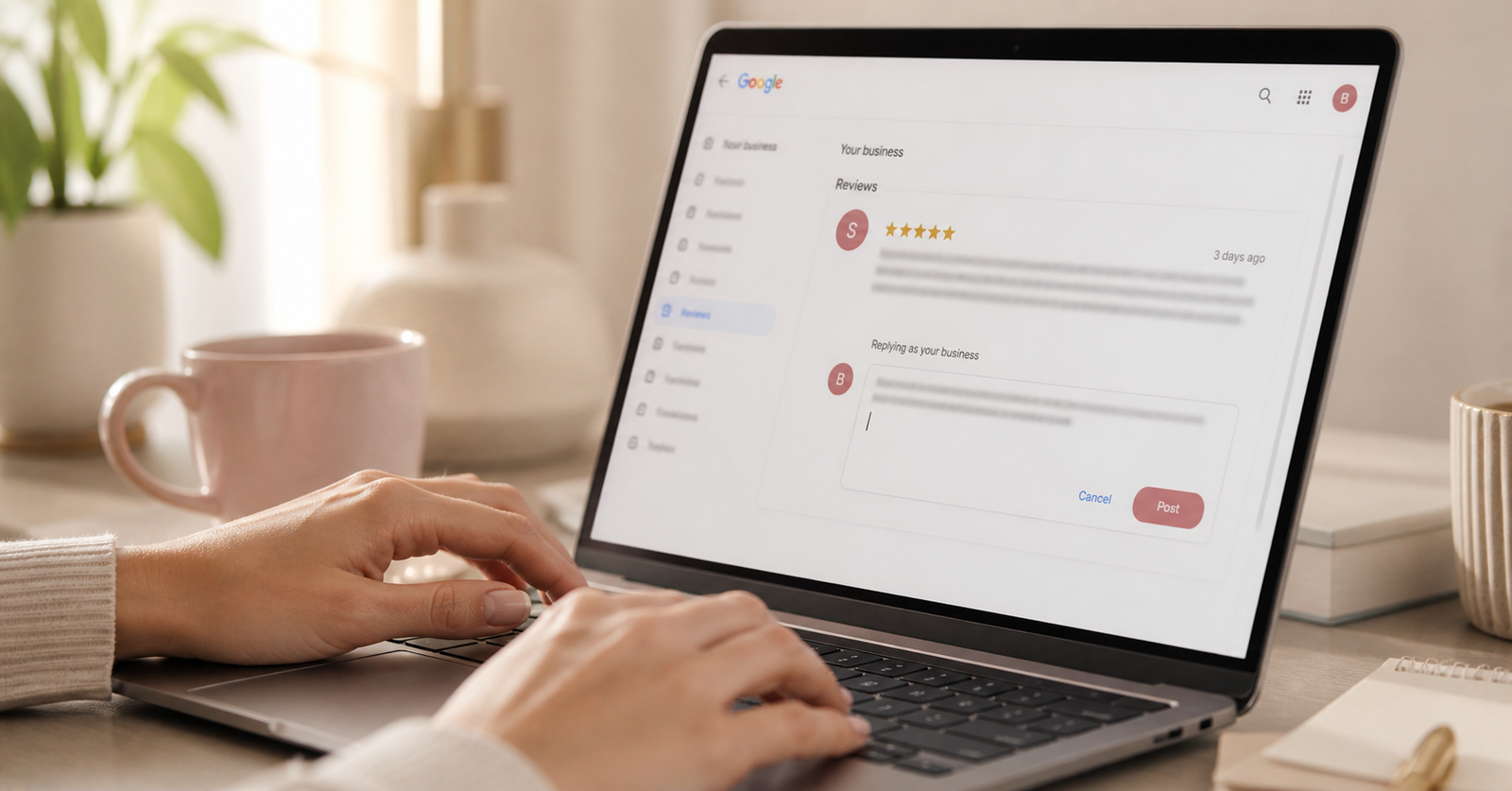
Most salon owners check their Google reviews, get a small adrenaline hit when they see something positive, get a bigger one when they see something negative, and then move on without responding. That's a missed opportunity at best — and an active brand damager at worst. In 2026, your review responses are public-facing brand content. Every prospective client reading your reviews is also reading your replies. The good news: responding well isn't complicated. There's a clear framework for both positive and negative reviews, a short list of things to never say, and a few specific moves that turn a bad review into a stronger trust signal than the original review damaged.
Why responding to reviews matters more in 2026 than ever
Three things have changed: 1) Google's algorithm now factors response rate and recency into local rankings, 2) AI-powered search engines like ChatGPT cite businesses with active engagement higher, and 3) prospective clients explicitly read responses before booking. A salon that responds to 100% of reviews materially outperforms one that ignores them — even at the same star rating.
The shift in 2026 is meaningful. Five years ago, review responses were a "nice to have." Today they affect three different ranking and conversion systems simultaneously.
Google ranking signals. Google's local search algorithm has explicitly added engagement signals — including response rate and response recency — to the factors that determine local pack visibility. A salon that responds within 24 hours to most reviews ranks better than an identical salon that doesn't. The signal isn't huge in isolation, but it compounds with other signals.
AI search citations. When ChatGPT or Perplexity recommends a salon, it's pulling from sources where engagement is structured and visible. Active responses signal a real, attentive business. Silence signals an absent or struggling one. AI-powered search tools have noticeably tilted toward citing engaged businesses.
Direct conversion. Internal data from review platforms consistently shows that prospective clients read review responses, especially on negative reviews. A graceful, professional response on a 2-star review often does more for conversion than three additional 5-star reviews would. Future clients want to see how you handle adversity — that's the real signal.
The takeaway: your responses are public content, not private replies. Write them like prospective clients are reading them — because they are.
How to respond to positive reviews (without sounding generic)
Reply to every positive review with two specific sentences: one that references something concrete from their experience, and one that warmly invites them back. Avoid copy-paste 'thank you for your kind words!' replies — clients can spot them instantly, and they signal that you're not actually paying attention.
The most common mistake with positive reviews is treating the response as a formality. "Thank you so much for the kind words! We hope to see you again soon!" copy-pasted across every review tells future clients you don't read what people write about you.
The framework that works:
- Open with their name. "Hi Jennifer," — humanizes the reply.
- Reference something specific. What did they mention? The balayage? Maya's consultation? The atmosphere? Pick one specific thing from their review and acknowledge it.
- Add a small genuine note. Something that shows the response was written by a person, not generated.
- Soft invitation back. Not "we hope to see you soon!" but something more specific.
Example. Original review: "Maya did the most beautiful balayage I've ever had. The whole salon vibe is so relaxing too."
Generic response (don't): "Thank you so much for the kind words, Jennifer! We're so happy you had a great experience! See you soon!"
Better response: "Hi Jennifer — so glad Maya nailed the balayage! She'd been talking about your color goal all morning, so I'll let her know the result landed. The 'salon vibe' compliment honestly made our day. See you in 7-8 weeks for your touch-up. ❤️"
What makes the second one work: specificity, the small detail about Maya, the timeline reference (subtly cues the next booking), and the genuine warmth. It costs maybe 90 extra seconds to write versus the generic version, and it's the difference between a forgettable reply and a brand asset.
One non-obvious thing: signing your responses matters. "— Maya" or "— Sarah, owner" feels like a real person responded. Unsigned responses feel corporate.
How to respond to negative reviews (the framework that actually works)
Use the LARA framework: Listen (acknowledge their experience), Apologize (for what you can genuinely own), Resolve (offer a path forward), Avoid (don't argue or defend). Respond within 24 hours. Move the conversation offline. Future clients reading the response care more about how you handled it than about the original complaint.
Negative reviews trigger emotional responses in salon owners — embarrassment, frustration, sometimes outrage if the review feels unfair. Almost every bad reply happens because the owner wrote it while still feeling those things. The framework that works requires getting to neutral first, then responding.
The LARA framework:
L — Listen / Acknowledge. Open by recognizing their experience, even if you disagree with their interpretation. "Hi Maria, thank you for taking the time to share this — I'm sorry your experience didn't meet expectations."
A — Apologize for what you can genuinely own. There's almost always something legitimate to acknowledge, even if you disagree with their version of events. Examples: "We should have communicated the pricing more clearly upfront." "It sounds like the consultation didn't fully capture what you were hoping for, and that's on us."
R — Resolve / Move offline. Offer to make it right, but move the detailed conversation off the public review. "I'd like to make this right — could you reach out to me directly at [email]? I'd love to discuss what happened and find a way to address it."
A — Avoid arguing or over-explaining. Even if you're right. Even if she's misremembering details. Even if she's flat-out lying. Public arguments damage your brand more than the original review did. Save the truth for the offline conversation.
Full example. Original review: 2 stars. "Booked a balayage and the result was nothing like what I asked for. The stylist seemed rushed and the color came out brassy. Disappointed."
Bad response (don't): "Hi Maria, with respect, you booked a budget service that doesn't include premium toner, which is why you experienced the brassiness. We discussed this at consultation. Sorry you're disappointed but our pricing reflects what's included."
That response is technically true and totally wrong. It tells every future client that this salon argues with customers.
Better response: "Hi Maria — thank you for the honest feedback, and I'm sorry the result wasn't what you were hoping for. Brassiness on the way the color landed is something we should have caught before you walked out. I'd like to talk through what happened and see how we can make it right — could you reach out to me directly at maya@studiosixsalon.com? I'd really appreciate the chance to fix this. — Maya"
What this does: acknowledges the experience, takes ownership of the controllable part (the result quality, the in-salon catch), offers a real path to resolution, doesn't argue. Future clients reading this see a salon owner who responds with grace under pressure. That's a powerful trust signal.
What to never say in a review response (the list)
Never argue with the client publicly, never name specific staff for blame, never reveal private details (like their service price or appointment time), never threaten legal action, never imply the client is lying, and never copy-paste the same response across multiple reviews.
The mistakes here are almost always made in the heat of the moment. Saving them as a list helps you check yourself before you submit.
Don't argue. "With respect, that's not what happened" is a sentence that has destroyed more salon reputations than any negative review. Even when you're right, public arguments are losses.
Don't name specific staff for blame. "I'll talk to Maya about this issue" sounds reasonable but throws an employee under the bus publicly. If you need to address it with staff, do it privately. Your public response handles it on behalf of the salon.
Don't reveal private details. Mentioning the client's specific service ("Your $185 balayage included…"), the time of their appointment, or any other identifying details creates legal exposure under privacy regulations and feels invasive to future clients reading the response.
Don't threaten legal action. Even if a review is genuinely defamatory, posting "We're consulting our attorney about this libelous review" is a brand catastrophe. Pursue legal options privately if needed; never make legal threats public.
Don't imply the client is lying. "I have no record of this appointment" or "This must be a different salon" — even when factually true — reads as defensive and combative. If you genuinely can't find the appointment, address it gracefully: "I want to look into this — could you reach out so we can verify the visit and address what happened?"
Don't copy-paste responses. Across both positive and negative reviews. Future clients can spot identical responses immediately, and it signals your engagement is performative, not genuine.
Don't write a response while emotional. The 24-hour rule: if a review hit you hard, draft your response, save it, and reread it the next morning. Almost every "I shouldn't have written that" reply was written within 30 minutes of reading the original review. Sleep on it.
When and how to flag a review for removal
Google removes reviews that violate its policies — including reviews from non-customers, fake reviews from competitors, reviews with profanity or hate speech, conflict-of-interest reviews (employees or family), and irrelevant content. Flag legitimate violations through your Google Business Profile, but don't expect every bad review to qualify.
Google's review removal policies are real but narrower than most salon owners hope. The reviews that genuinely qualify for removal:
- Reviews from people who weren't actually customers. If you have no record of the service, no record of the client, and the review describes events that didn't happen — flag it as "not a customer."
- Reviews containing hate speech, profanity, or personal attacks. Google removes these consistently when reported.
- Reviews from competitors. If you can demonstrate it's from a competitor (matching IP patterns, naming a competitor salon in their review, etc.), flag it as conflict of interest.
- Reviews from former employees with a grievance unrelated to service quality. These violate Google's conflict-of-interest policy.
- Reviews containing private information about other clients. Sharing other people's appointment details, names, or personal info is a clear violation.
- Reviews that are clearly off-topic. Someone reviewing your salon based on their experience at a different business, or reviewing the parking situation in your shopping center, etc.
What does NOT qualify for removal:
- Reviews you disagree with
- Reviews where the client misremembers details
- Reviews that are unfairly harsh
- Reviews from clients who had a real but bad experience
- Reviews you think are unreasonable
How to flag a review: open your Google Business Profile, find the review, click the three-dot menu, select "Report review," and choose the violation type. Add detail in the explanation field. Review removal usually takes 5-15 business days; some get removed, some don't.
Strategic note: even when a review qualifies for removal, the response you've already posted publicly is still doing work for you. So respond first, flag second. Don't wait for the flag outcome before replying.
What to do with fake or malicious reviews
Document everything, respond calmly in public, flag the review through Google, and consult a lawyer if it crosses into defamation. Never respond emotionally, never expose the reviewer's identity, and never engage in a public back-and-forth. Most fake reviews lose their power against a calm, professional response.
Fake reviews are a real and growing problem in 2026. They come from competitors, disgruntled former employees, ex-partners of clients, and occasionally from professional review-bombing services. Most salons will encounter at least one over the life of their business. The framework for handling them:
Step 1: Document, don't react. Screenshot the review. Note the timestamp. If you have any reason to believe it's from a specific person or business, document that suspicion privately — not in your response.
Step 2: Respond publicly, calmly, and briefly. Even if you're 95% sure the review is fake, respond as though there's a small chance it might be a real client you can't immediately identify. Template:
"We take all feedback seriously, but we're not finding a record of this visit in our booking system. If you've had a real experience at our salon, we'd love to look into it — please reach out directly at [email]. — [Owner name]"
Why this works: it doesn't accuse, it doesn't argue, it offers a real verification path, and it implicitly signals to future readers that this review may not be legitimate without explicitly saying so.
Step 3: Flag through Google. Use the appropriate violation reason (not a customer, conflict of interest, etc.). Provide as much detail as you can in the explanation field.
Step 4: Consult a lawyer if it crosses lines. If the review contains demonstrably false statements that damage your business, names specific employees in defamatory ways, or is part of a coordinated review-bombing pattern from an identifiable source — talk to a small-business attorney. Defamation law for online reviews is complex but real. Most cases don't go to litigation; a cease-and-desist often resolves things.
What never to do:
- Publicly accuse the reviewer or name who you think it is
- Threaten legal action in the response
- Pay a "review removal service" — most are scams or violate Google's policies and can get your listing suspended
- Buy positive reviews to drown out the fake negative — Google detects this and the penalties are severe
- Post about it on social media in a way that could escalate
The hard truth: occasionally a fake review survives all of this and stays on your profile. The best long-term defense is volume — a steady stream of legitimate positive reviews makes any single fake review increasingly invisible. We covered review acquisition strategy in detail in our guide to getting more salon reviews.
What to do this week to fix your review response system
1) Respond to every unanswered review on your Google Business Profile, going back at least 6 months. 2) Set up email notifications for new reviews. 3) Write 3 template starting points (positive, mildly negative, seriously negative) — but never copy-paste exactly. 4) Commit to a 24-hour response time going forward.
If your review responses have been inconsistent, here's the fix-it-this-week plan.
This week:
- Audit and respond to past reviews. Go back at least 6 months. Respond to every unanswered review. Yes, even the old positive ones — late is better than never, and prospective clients see all reviews regardless of date.
- Turn on review notifications. In Google Business Profile, enable email and mobile notifications for new reviews. You can't respond fast if you don't know about them.
- Write three starting templates. One for positive reviews, one for moderate complaints, one for serious complaints. These are starting points — every actual response should be customized — but having a structure prevents writer's block at the moment when you need to respond fast.
This month:
- Commit to a 24-hour response window. Every review, every time, within 24 hours. Make it a habit. The signal compounds over time.
- Review your past responses for the patterns to avoid. Check the "what to never say" list against your old responses. If you find any, you can edit them — Google allows response editing.
- Track what happens. Note your monthly review count, average rating, and response rate. Set a 90-day check-in. Most salons see meaningful Google ranking improvements within 60-90 days of consistent response habits.
The salons that win on reviews in 2026 aren't the ones with the most 5-stars — they're the ones that respond thoughtfully to every review, every time. The compounding effect on local SEO, AI search visibility, and direct conversion is significant. The work is small. The payoff is real.
Frequently Asked Questions
How quickly should I respond to a Google review?
Within 24 hours is the standard to aim for. Same-day responses are even better, especially for negative reviews where a fast, graceful response can defuse situations before they escalate. Salons that respond within hours signal a level of attentiveness that prospective clients notice and trust.
Should I respond to old reviews from years ago that I never replied to?
Yes. Late responses are still meaningfully better than no responses. Prospective clients reading your reviews see all of them, not just recent ones. A short, gracious response on a 3-year-old positive review is appreciated and signals that you genuinely engage. Don't apologize for the lateness — just respond as though you're catching up on something important.
What if a client emails me asking me to remove their negative review after we resolved the issue offline?
You can't remove the review yourself — only the reviewer can edit or delete their own review through their Google account. If you've genuinely resolved the issue, you can ask the client if they'd be willing to update the review with their experience. Many will. Just be careful: never offer money, services, or anything of value in exchange — it violates Google's policies and can backfire badly.
Is it okay to ask satisfied clients to leave a positive review after I've responded to a negative one?
Yes — and it's actually one of the most effective recovery tactics. A wave of fresh positive reviews dilutes the impact of a negative one in your overall rating and pushes it down the visible list. The right way to do this is through your standard review acquisition system (we covered this in detail in our review acquisition guide), not by directly asking clients to 'help counter' the negative review. Keep the request clean and focused on their experience.
Should I respond to reviews on Yelp, Facebook, and other platforms too?
Yes — though Google should be your priority since it has the highest impact on local SEO and is most visible to prospective clients. The same response principles apply across platforms. The main difference is volume: most salons get most reviews on Google, fewer on Yelp, almost none on Facebook in 2026. Cover Google fully, then cover Yelp, then deprioritize the rest.
Can I have my staff respond to reviews on my behalf?
Yes, but with two caveats. First, the responses should still feel personal and signed by a real person — preferably you, the owner, or a senior staff member. Second, reviews about specific staff should ideally be answered by you, not by the staff member being reviewed (it can feel awkward to readers). For most independent salons, the owner handling reviews directly is the cleanest model. As you grow, this becomes harder to scale, but the personal touch matters.