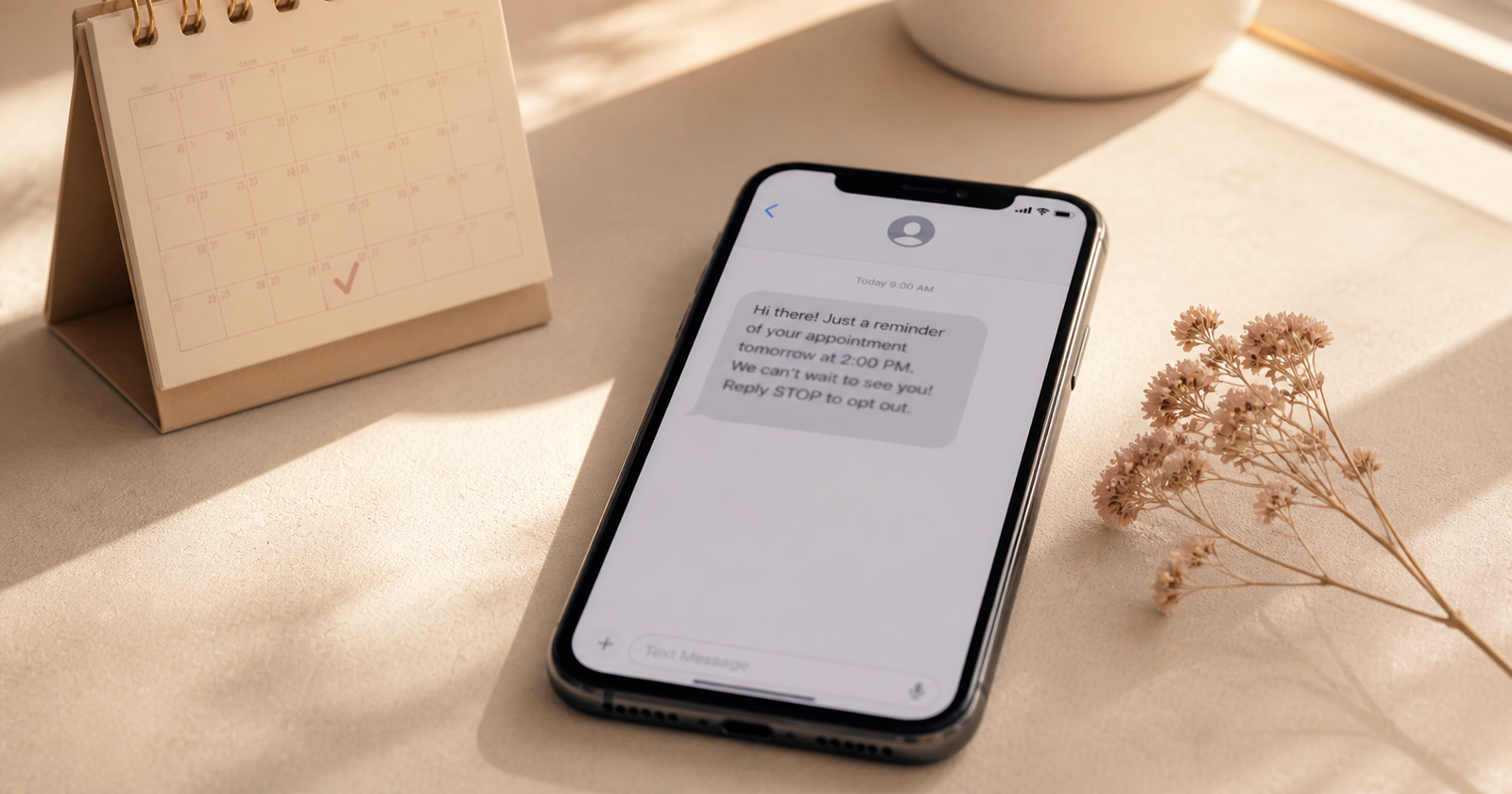
There's a strange asymmetry in how salons think about clients. Acquiring a new client costs $80-$200 in marketing spend, depending on the market. Bringing back a lapsed client costs almost nothing — except most salons don't try. The client books, comes once, doesn't return, and the salon never reaches out. Six months later, that client is going somewhere else, and the salon is paying $150 to acquire someone new. This post walks through the email and SMS sequences that fix the leak, with specific templates, timing, and the tactical details that separate retention messages clients actually open from ones that go straight to spam.
Why retention beats acquisition (and the math nobody runs)
It costs roughly 5x more to acquire a new salon client than to bring back a lapsed one. A retention rate increase of just 5% typically increases salon profits by 25-95%. Yet most salons spend 90% of their marketing energy on acquisition.
Almost every salon owner intuitively knows retention matters. Almost none have run the actual numbers on their own business.
Here's a typical hidden math problem. Say a salon has 400 active clients, with average annual spend of $480. That's $192,000 of revenue from existing clients per year. If 30% of those clients lapse each year (very common), that's 120 clients × $480 = $57,600 of revenue walking out the door annually.
To replace that revenue, the salon needs to acquire 120 new clients per year. At $150 acquisition cost, that's $18,000 in marketing spend just to stay flat.
Now run the same math with a 5% retention improvement. Lapsed clients drop from 120 to 100. The salon retains $9,600 more revenue and needs $3,000 less marketing spend. That's a $12,600 swing on a single 5% retention improvement — and most salons can hit that with a few automated emails and texts.
The strategic point: retention isn't just about being nice to clients. It's the highest-leverage financial move a salon can make. A salon that fixes its retention has effectively unlocked free growth — the same client base, generating more revenue, at lower marketing cost.
The reason this gets ignored: acquisition feels exciting (new clients! growth! social media!) and retention feels boring (sending emails to people who've already paid you). The numbers tell a different story than the feeling does.
The five retention sequences every salon needs
The five highest-impact salon retention sequences are: 1) the post-appointment follow-up (24-48 hours after), 2) the rebook nudge (timed to your service interval), 3) the lapsed-client reactivation (60-90 days), 4) the birthday touch, and 5) the pre-appointment confirmation/reminder. Together these typically lift retention by 8-15%.
Retention isn't one email. It's a system of small, well-timed touches that keep your salon top of mind without being annoying. The sequences that consistently work for beauty businesses:
1. The post-appointment follow-up (24-48 hours after).
Sent automatically the day after the appointment. Two-line warm message: "Hope you're loving the result!" + brief care tip + soft "let us know if anything's not right." Goal: catch any small issues before they become bad reviews, reinforce the connection, set up the next visit.
2. The rebook nudge (timed to service interval).
Sent 1-2 weeks before the next appointment is due. "Sarah, your last balayage was 6 weeks ago — you're due for a refresh. Here's a quick link to grab a slot." Goal: catch the client before they start the "I should book…" mental loop that turns into 4 months of procrastination.
3. The lapsed-client reactivation (60-90 days).
Sent when a client hasn't booked within their normal cycle. "It's been a while — we've missed you. Anything we can help with?" Optional: a small reactivation incentive (a complimentary upgrade on the next visit, not a discount). Goal: bring back the 20-30% of clients who quietly drift away each year.
4. The birthday touch.
A short message on or around their birthday. Either an actual gift (a complimentary deep conditioner upgrade on next visit) or just a warm note. Goal: reinforce that they're a person to you, not a transaction. The gift framing matters less than the gesture.
5. The pre-appointment confirmation/reminder.
This is technically a no-show prevention tool, but it doubles as retention. 48 hours and 2 hours before each appointment. We covered this in detail in our no-shows guide.
The sequence to launch first if you're starting from zero: the lapsed-client reactivation. It's the one that immediately recovers revenue. The rebook nudge is the second priority because it prevents the lapse in the first place.
Email vs SMS: when to use each (and why most salons get this wrong)
SMS is for time-sensitive, high-priority messages: rebook nudges, appointment reminders, last-minute openings. Email is for content-rich, relationship-building messages: post-appointment care tips, monthly updates, occasional value content. Using the wrong channel for the wrong message is why most salon retention messaging gets ignored.
The single biggest tactical mistake salons make in retention is sending everything by email. The reason: their booking software defaults to email, and they don't change it.
The honest channel performance numbers in 2026:
- SMS open rates: 90-98%, with most read within 5 minutes
- Email open rates: 18-28% for salon emails, with most never opened
- SMS reply rates: 30-45% for personalized messages
- Email reply rates: 1-3% for the same message content
SMS isn't always better — it's stricter. SMS feels intrusive if used for low-priority content. The framework that works:
Use SMS for:
- Appointment reminders and confirmations
- Rebook nudges (when timing matters)
- Last-minute openings ("just had a cancellation Saturday at 2 PM if you want it")
- Lapsed-client reactivation (one or two messages, not a sequence)
- Birthday wishes (short, warm)
Use email for:
- Post-appointment care tips (longer-form is fine)
- Monthly newsletter content (industry tips, new services, content marketing)
- Detailed promotional announcements (price changes, new staff, new services)
- Lapsed-client reactivation sequences (where SMS would feel pushy after one or two)
The hybrid model that works best: a short SMS nudge that drives the client to a longer email or your website. Example: "Sarah, you're due for a refresh — full details on what's new since your last visit are in your inbox." This respects the brevity SMS demands while letting the email do the longer work.
One non-obvious thing: clients have to opt in to SMS in most jurisdictions (TCPA in the US is increasingly enforced). Make sure your booking flow has an explicit "I'd like to receive SMS reminders and updates" checkbox — and respect it. Sending SMS to clients who didn't opt in is both bad form and legally risky.
The rebook nudge: timing, message, and the small details that matter
Send the rebook nudge 1-2 weeks before the client's typical service interval expires. Reference the specific previous service and date. Include a one-tap booking link. Avoid hard sells — frame it as a friendly heads-up, not a marketing push.
The rebook nudge is the single highest-impact retention message most salons aren't sending. The math: if 60% of your clients book again on their natural interval, but only 35% of them initiate the booking themselves, the rest are quietly drifting unless you reach out.
The ideal timing depends on the service:
- Balayage / highlights: 8-10 weeks (send nudge at week 6-7)
- Single-process color / root touch-up: 4-5 weeks (send nudge at week 3)
- Haircut: 6-8 weeks (send nudge at week 5-6)
- Lash fills: 2-3 weeks (send nudge at day 10-14)
- Brow services: 4-6 weeks (send nudge at week 3-4)
The message itself should be short, warm, and specific. Template:
"Hi Sarah! It's been about 7 weeks since your balayage — usually a good time for a refresh. Want me to grab you a slot? Here's my next two weeks of openings: [link]. — Maya"
What makes this work:
- Personal sender. "Maya" not "AI Targeted Salon" or "Studio Six Bookings."
- Specific timing reference. "About 7 weeks since your balayage" beats "It's time for your next appointment."
- Direct link. Tap, see availability, book. No five-step process.
- Friendly, not pushy. "Want me to grab you a slot?" leaves room for a "yes" or "not yet, thanks" — both are fine outcomes.
- No discount or urgency manufacturing. Don't say "limited slots!" or offer 10% off. The relationship is the value, not the discount.
Salons that implement this single sequence — and only this sequence — typically see 5-12% retention lift within 90 days. It's the highest-ROI automation a salon can build.
The lapsed-client reactivation sequence
When a client hasn't booked within 1.5x their normal interval, run a 2-message sequence: a warm 'we've missed you' SMS, and 7-10 days later if no response, a longer email asking if anything changed. Add a small value-add (free upgrade, not a discount) to the second message. This typically reactivates 15-25% of lapsed clients.
Some clients lapse for predictable reasons — they moved, they're going through something hard, they tried a new salon and liked it. Others lapse for invisible reasons — they had one underwhelming visit, they kept meaning to book, life got busy. The reactivation sequence is built for the second group.
The trigger: client hasn't booked within 1.5x their normal service interval. For a balayage client whose typical cycle is 8 weeks, that means 12 weeks of silence triggers the sequence.
Message 1 (SMS, day 0 of trigger):
"Hi Sarah, it's Maya at Studio Six! I noticed it's been a bit longer than usual since your last appointment — just wanted to check in. Hope everything's good! If you're ready to come back, here's a link with my next openings: [link]"
Notice what this isn't doing: no discount, no apology, no guilt. Just a warm acknowledgment plus a low-friction return path.
Message 2 (email, 7-10 days later, only if no response):
Subject: "Anything we can do better?"
"Hi Sarah,
I sent a text last week and didn't hear back, which is totally fine — life gets busy. I just wanted to make sure that if there's anything from your last visit that wasn't quite right, I'd love to know. Either way, your next appointment is on us for a complimentary deep conditioning treatment ($35 value) when you come back — just mention this email.
No expiration, no pressure. We'd love to see you again whenever the timing's right.
— Maya"
What works in this email:
- The "anything we can do better" framing. It opens a door for honest feedback. About 1 in 8 lapsed clients will share something specific — and that feedback is genuinely useful.
- The free upgrade, not a discount. Adding $35 of value preserves your pricing integrity. Discounting "30% off your next visit!" trains them to expect deals and damages your perceived value.
- No expiration date. Counter-intuitive but high-impact. An expiration date adds urgency but also pressure, which lapsed clients respond to badly. The open-ended offer feels like a real gesture, not a sales tactic.
- Personal sign-off. Always from the actual stylist or owner, never "the team."
What to do after Message 2: nothing. If the client doesn't return after this sequence, stop reaching out. A third message starts to feel pestering. Add them to a "do not contact" segment and let them go gracefully. Many will return on their own months later — coming back to a salon that didn't harass them is easier than coming back to one that did.
What to skip (the retention messages that hurt)
Skip: weekly email newsletters, generic 'just because' sales, holiday-themed promotional emails, AI-generated 'tips' content, and any message that doesn't reference the specific client. Each of these makes your salon feel like a marketing engine instead of a relationship.
Bad retention messaging is worse than no retention messaging. It actively damages the relationship. The patterns to avoid:
Weekly newsletters. Most salons don't have weekly content worth sending. Forcing it produces filler that gets ignored or unsubscribed. Monthly is the maximum sustainable cadence for content emails. If you can't fill a monthly email with genuinely useful content, send less frequently.
Generic "just because" promotions. "Spring is here — book your refresh!" with no personalization, no specific reason, no real value. These get marked as spam quickly and train your inbox reputation downward.
Holiday-themed promotional emails. "Mother's Day special!" "Halloween hair specials!" "Black Friday salon deals!" These feel cynical and out of character for most salons. The exception: a single Mother's Day or Valentine's gift card promotion can work if it's restrained and genuinely service-oriented.
AI-generated "5 tips" content. Increasingly common in 2026. Clients can spot AI filler instantly. If you're going to send tips, write them yourself or have your stylist write them. Three sentences of genuine, specific advice beat 800 words of AI-generated wallpaper.
Messages with no personalization. "Dear Valued Client" emails are the fastest path to the spam folder. Even basic merge tags (first name, last service) signal effort and dramatically improve performance.
Reactivation incentives that compound. If your reactivation offer is "30% off your next visit," and you also run a "10% off first visit" promotion, and you also do birthday discounts, your clients will quickly learn that paying full price is for suckers. Pick one or two strategic offers and stop there.
The principle underlying all of these: retention messaging works because it feels like the salon remembers and cares. Anything that makes the messaging feel like a marketing engine breaks that perception. Less, more thoughtful, more personal — always wins over more, generic, automated.
What to do this week to build your retention system
1) Set up the rebook nudge automation in your booking software. 2) Write the lapsed-client reactivation sequence (one SMS + one email). 3) Audit your existing email and SMS messages for personalization and tone. 4) Pick a quarterly review cadence to refine what's working.
You don't need a marketing automation platform to start. Most modern salon booking software (Boulevard, Vagaro, Square Appointments, Booker, Fresha) has SMS automation built in.
This week:
- Set up the rebook nudge. In your booking software, find the SMS automation section. Create a trigger: send X days before client's typical re-service date. Use the template above. Test it on yourself first.
- Write your lapsed-client reactivation sequence. One SMS (day 0 of trigger) and one email (day 7-10). Use the templates above as starting points; adjust to your brand voice.
- Audit any existing automated messages. Read every automated message your booking software currently sends. Are any of them robotic, generic, or missing personalization? Rewrite them.
This month:
- Add the post-appointment follow-up. 24-48 hours after each appointment. Short, warm, with a care tip relevant to the service.
- Build a birthday touch. Most booking software stores client birthdays. Set up an automated SMS or email on or before their birthday with a small gesture.
- Track your retention rate. Pull a 12-month report. What percent of clients from a year ago booked again in the last 12 months? Set a baseline. Re-measure in 90 days after the sequences are running.
The biggest predictor of which salons will be financially healthy in 2027 isn't acquisition — it's retention. Every percentage point of retention lift compounds for years. The work to build these sequences is a weekend. The financial return runs into five and six figures over the life of your business.
Frequently Asked Questions
What's a healthy salon retention rate in 2026?
Industry benchmarks for salon retention land around 60-75% for established salons, measured as the percentage of clients from 12 months ago who booked again in the last 12 months. Top-performing salons hit 80%+. Below 50% is a serious problem that almost always points to either service inconsistency or absent retention systems.
How often should I email my client list?
Once a month is the sustainable maximum for most salons. Less frequent is fine if you don't have content worth sending. Weekly is usually too much and trains people to unsubscribe. The exception is automated transactional messages (appointment reminders, rebook nudges, follow-ups) — those don't count toward this cadence and should run on their own triggers.
Are paid email/SMS marketing platforms worth it for a small salon?
If your booking software has built-in SMS and email automation (most do in 2026), you don't need a separate platform until you outgrow it. Adding Klaviyo or Mailchimp on top of your existing booking software is usually overkill for salons under $500k revenue. Once you're past that, dedicated platforms add real value through segmentation and analytics.
Should I segment my client list?
Light segmentation is helpful: new clients (first 90 days), regulars (booked 3+ times), VIPs (high spend or referrers), and lapsed (60+ days inactive). Heavy segmentation by demographics, service preference, etc. is usually over-engineering for salons. Start with the four above and refine if you find specific patterns worth segmenting.
How do I handle clients who unsubscribe from emails or opt out of SMS?
Respect it immediately and permanently. Unsubscribes happen — sometimes the client just prefers booking through your app, sometimes they're decluttering their inbox, sometimes they're unhappy. Trying to win them back through other channels (or worse, re-adding them) damages trust and can violate CAN-SPAM and TCPA regulations. The right move is to honor the opt-out, deliver excellent in-person service, and let the relationship stand on its own.
What's the right tone for retention messaging?
Warm, specific, personal — like you'd write to a friend you genuinely like, not like a marketing copywriter. The clearest test: read the message out loud. If you'd be embarrassed to actually say it to the client, rewrite it. Salons that nail retention messaging sound like the actual humans who own them, not like a corporate brand voice.