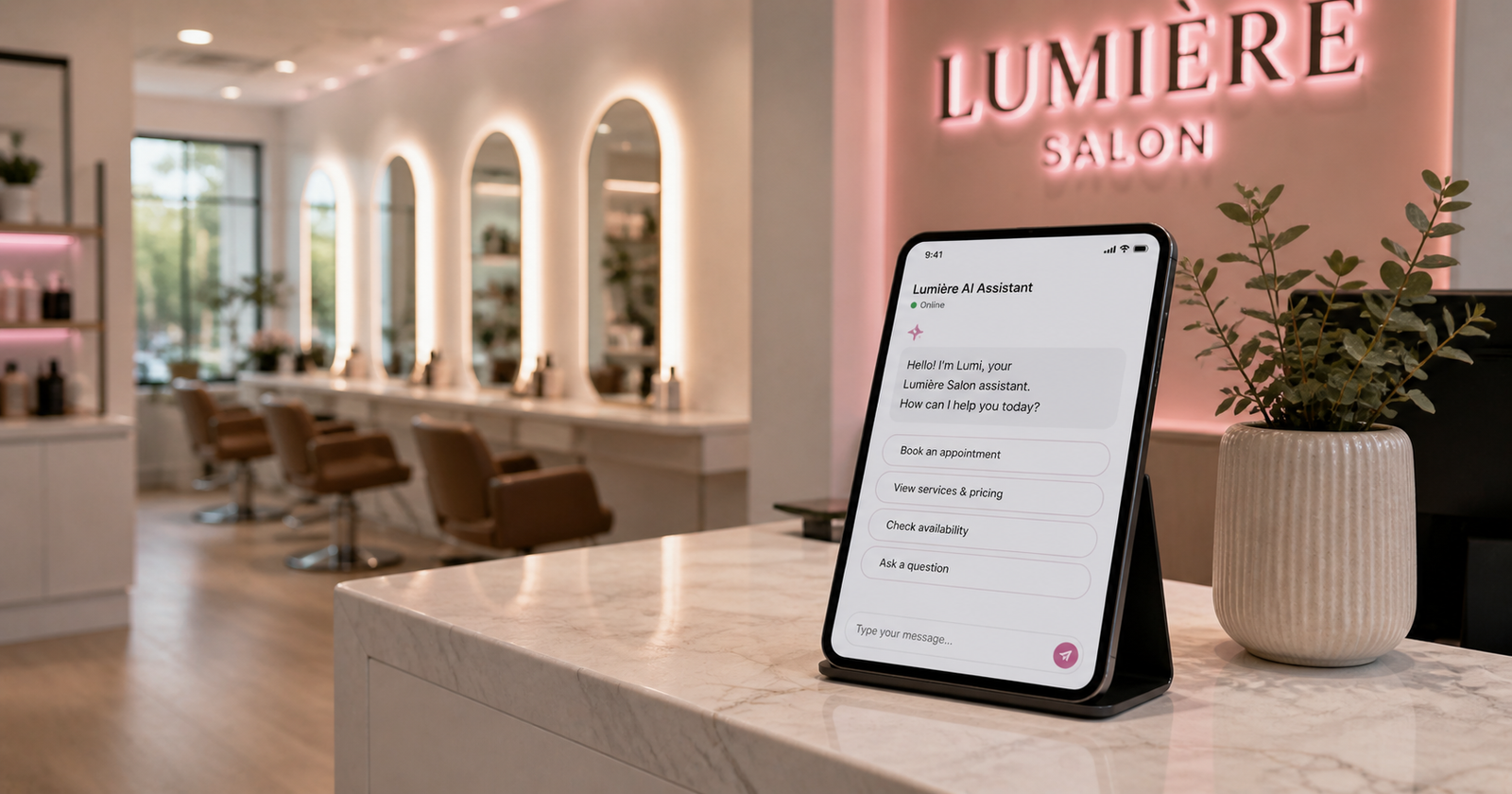
Two things are true at the same time: AI receptionists are dramatically better than they were even a year ago, and they're being oversold by every booking platform with a chatbot to push.
If you've been hearing about "24/7 AI receptionists" for salons and wondering whether to actually try one, this guide cuts through the hype. We'll cover what AI receptionists actually do today (vs. what marketing pages claim), when they pay for themselves, when they hurt your business, and how to evaluate one before signing up.
What an AI receptionist actually does
A modern AI receptionist answers phone calls and messages 24/7, books and reschedules appointments directly into your calendar, answers common questions about services and pricing, and routes complex requests to a human. The good ones sound natural; the bad ones sound like robots from 2015.
The term "AI receptionist" covers a wide range of tools, from basic chatbots that match keywords to scripted answers, all the way to conversational AI that can hold a multi-turn conversation about hair color formulas. Worth understanding the difference before evaluating tools.
The capabilities of a competent 2026 AI receptionist:
- Answers phone calls 24/7 with a voice that sounds human (not the robotic tones of older systems)
- Books, reschedules, and cancels appointments by writing directly into your booking software
- Answers questions about services, pricing, and policies by reading from your service menu and FAQ
- Sends appointment confirmations and reminders via SMS or email automatically
- Identifies high-priority situations and escalates to a human (an angry client, a complex consultation request, a complaint)
The capabilities a 2026 AI receptionist genuinely cannot handle yet:
- Subjective hair consultations ("What color would look good on me?")
- Pricing negotiations
- Specific creative requests where context matters
- Real complaints requiring empathy and on-the-fly judgment
The good news is that the things AI handles well (booking, FAQ, confirmations) are roughly 80% of what a human receptionist does. The things AI doesn't handle are the 20% where you'd want a human anyway.
Why this technology suddenly matters in 2026
Three things changed: AI voice quality became indistinguishable from human, client expectations shifted to 24/7 availability, and the cost dropped low enough for solo studios. Surveys show 66% of salon clients now see AI receptionists as 'extremely or very valuable.'
If you tried an AI phone tool in 2022 or 2023 and gave up because it sounded robotic, you'd be forgiven for assuming the technology hasn't moved. It has — dramatically.
Three shifts converged in 2025-2026 to make AI receptionists genuinely viable for salons:
Voice quality crossed the uncanny valley. Modern AI voice models now produce speech with natural pauses, intonation, and conversational filler that's genuinely hard to distinguish from human speakers in short calls. Most clients don't realize they're talking to AI unless told.
Client expectations shifted to 24/7. Recent surveys of salon clients show that 71% have decided not to book with a salon because reaching them was too hard, and 63% said they're more likely to choose a salon that allows assistance outside normal hours. The cost of being unreachable went up, sharply.
Pricing dropped to single-chair territory. The first generation of AI receptionists were enterprise tools at enterprise prices ($500-2,000+ per month). The 2026 generation runs $50-200 per month for most salon use cases — comparable to an hour or two of a part-time receptionist.
The combination means AI receptionists moved from "interesting tech" to "defensive necessity" in many markets. Salons not using them are losing bookings to salons that are.
The math: when AI receptionists pay for themselves
Most salons need to capture 1-2 additional appointments per month to break even on AI receptionist costs. Salons that miss many calls during busy hours typically see 5-15× ROI within the first 90 days.
Whether an AI receptionist makes financial sense for your salon comes down to a single number: how many bookings are you currently losing because you can't answer the phone or respond to messages?
Here's the simple math:
Most AI receptionist tools cost $50-200 per month. The average salon service is $80-200. So you need to capture 1-2 additional appointments per month that you would have missed otherwise to break even.
The places this math works strongly in your favor:
- Salons that miss calls during service hours. Every missed call is a potential lost booking. AI picks up every call.
- Salons that don't have weekend or evening coverage. Clients searching at 9 PM Sunday are high-intent. If you can't book them, they book a competitor.
- Salons with multiple stylists or locations. The volume of incoming requests scales, but a single AI receptionist handles all of them.
Where the math gets weaker:
- Solo stylists with very low volume. If you only get 5-10 phone bookings a month, you might genuinely answer them all yourself.
- Salons with strong online booking already. If 90%+ of your bookings come through your website without phone or DM contact, an AI receptionist has less to do.
For most salons in between — moderate volume, sometimes-missed calls, real demand for after-hours bookings — the ROI is meaningful and shows up within 30-60 days.
How to evaluate an AI receptionist before buying
Test the AI receptionist by calling it yourself with realistic scenarios — booking, rescheduling, asking about pricing, asking a tricky service question. If it sounds robotic, gives wrong answers, or gets stuck, it'll do the same to your clients.
The marketing pages for AI receptionist tools all claim the same things: natural voice, 24/7 availability, books appointments, integrates with your software. The actual quality varies enormously. Don't trust the marketing — test it yourself.
Most tools offer a free trial or demo number you can call. Use it. Run through realistic scenarios:
Test 1: A simple booking. "Hi, I'd like to book a balayage on Saturday afternoon." Does the AI handle the booking smoothly? Does it understand service names? Does it actually write the appointment into the test calendar?
Test 2: A reschedule. "I need to move my appointment from Tuesday to Thursday." Reschedules require the AI to find the existing appointment and modify it. Many tools struggle here.
Test 3: An ambiguous question. "Do you do extensions?" If the AI rigidly says "I don't have information on that" instead of checking your service menu and answering, it'll do the same to your real clients.
Test 4: A weird interruption. Halfway through booking, change your mind: "Actually, can you also tell me about your gloss services?" Does the AI handle the context shift gracefully or does it lose track?
Test 5: Off-script frustration. Say something like "This is taking forever, can I just talk to a person?" Does the AI escalate to a human or keep cycling through scripts? The good ones gracefully hand off; the bad ones argue.
If the AI fails any of these tests, it'll fail with your real clients too — and unhappy AI experiences are worse than no AI at all.
When NOT to use an AI receptionist
Avoid AI receptionists if your booking volume is very low, your client base is older or strongly prefers human contact, or you can't commit to monitoring and improving the AI's responses for the first 60-90 days.
AI receptionists aren't right for every salon. Some signals that you should hold off:
Your client base strongly prefers human interaction. Some salons (especially traditional barbershops, older clientele, high-end concierge salons) build their brand around personal phone contact. AI can feel jarring in those contexts. Your gut instinct on this is usually right.
Your booking volume is genuinely low. If you're a solo stylist getting 30-40 bookings a month and answering them yourself works fine, the ROI on AI is weak. Wait until volume grows.
You can't commit to monitoring and tuning. AI receptionists need 60-90 days of close attention to learn your specific service menu, FAQ, and edge cases. Salons that buy and forget often have AI making mistakes that cost more than the bookings they capture. If you can't dedicate at least an hour a week to reviewing AI conversations and updating its responses, the tool will hurt you.
Your booking software doesn't integrate with the AI tool. Most modern salon software (Booksy, Vagaro, Square Appointments, etc.) has AI integrations. If you're on a niche platform that doesn't, the AI can't actually book appointments — it can only take messages, which is far less valuable.
If any of these apply, it's not that AI is bad; it's that the timing is wrong. Better tools, better integrations, and a stronger fit for your business are worth waiting for.
What to look for when comparing AI receptionists
Five non-negotiables: natural voice quality, direct booking software integration, customizable service menu and FAQ, transparent escalation to humans, and clear pricing without hidden per-minute charges.
If you've decided AI receptionist makes sense for your salon, here's what separates a tool worth buying from one that'll waste your money.
Voice quality. Test the actual voice. Does it sound natural? Does it have appropriate pauses and inflection? Voice models from 2024 and earlier are dramatically worse than 2026 models — you'll hear the difference immediately.
Direct booking integration. The AI should read from and write to your existing booking calendar in real time. "Sends booking requests to your inbox" is not the same as "books the appointment." Push back on this — it's the single biggest functional difference between competent and weak tools.
Customizable knowledge base. You should be able to upload your service menu, pricing, policies, FAQ, and stylist specialties so the AI gives accurate answers. Tools that try to be "plug and play" without customization usually give wrong answers.
Graceful human escalation. When the AI doesn't know something or the client gets frustrated, it should hand off to a human (you, a manager, a virtual assistant) cleanly. Tools that keep cycling through scripted responses when stuck are worse than no AI at all.
Transparent pricing. Watch for tools that charge per call, per minute, or per booking. These costs add up unpredictably. Flat monthly pricing with a clear call/booking cap is much easier to budget for.
Tools to look at as starting points (this isn't an endorsement — your evaluation should be tool-by-tool): Goldie's AI add-on, Boulevard's AI receptionist, Voiceflow + booking integrations, and several specialized salon-AI tools that have launched in 2025-2026. The space is moving fast — what's best in 2026 may not be best by 2027.
Frequently Asked Questions
How much does an AI receptionist for a salon cost in 2026?
Will my clients know they're talking to AI?
Can an AI receptionist handle complex consultations?
What happens if the AI makes a mistake?
Do I still need a human receptionist if I have AI?
How long does it take to set up an AI receptionist?
Ready to see what's costing your salon clients?
Get a free audit of your website, booking flow, and Google visibility. No cost, no pressure, delivered within one business day.
Contact Us